← All case studies

INDEPENDENT CAR SALES · DIGITAL WORKFLOW · CUSTOMER EXPERIENCE

A personal way of selling cars

A simple website and admin system built around the way Matthew works — not the other way round.

Matthew Loyn Car Sales is a small, appointment-only used car business in Cardiff, built around something quite simple: Matthew knows the cars he sells and prefers dealing with customers himself. So we didn’t start by asking, “What should a car dealer website have?” We started with, “How does Matthew actually work — and where could a website make that easier?” The result is a simple digital system connecting cars, advertising, enquiries, reviews and day-to-day admin, while keeping Matthew’s experience and his direct relationship with customers at the centre.

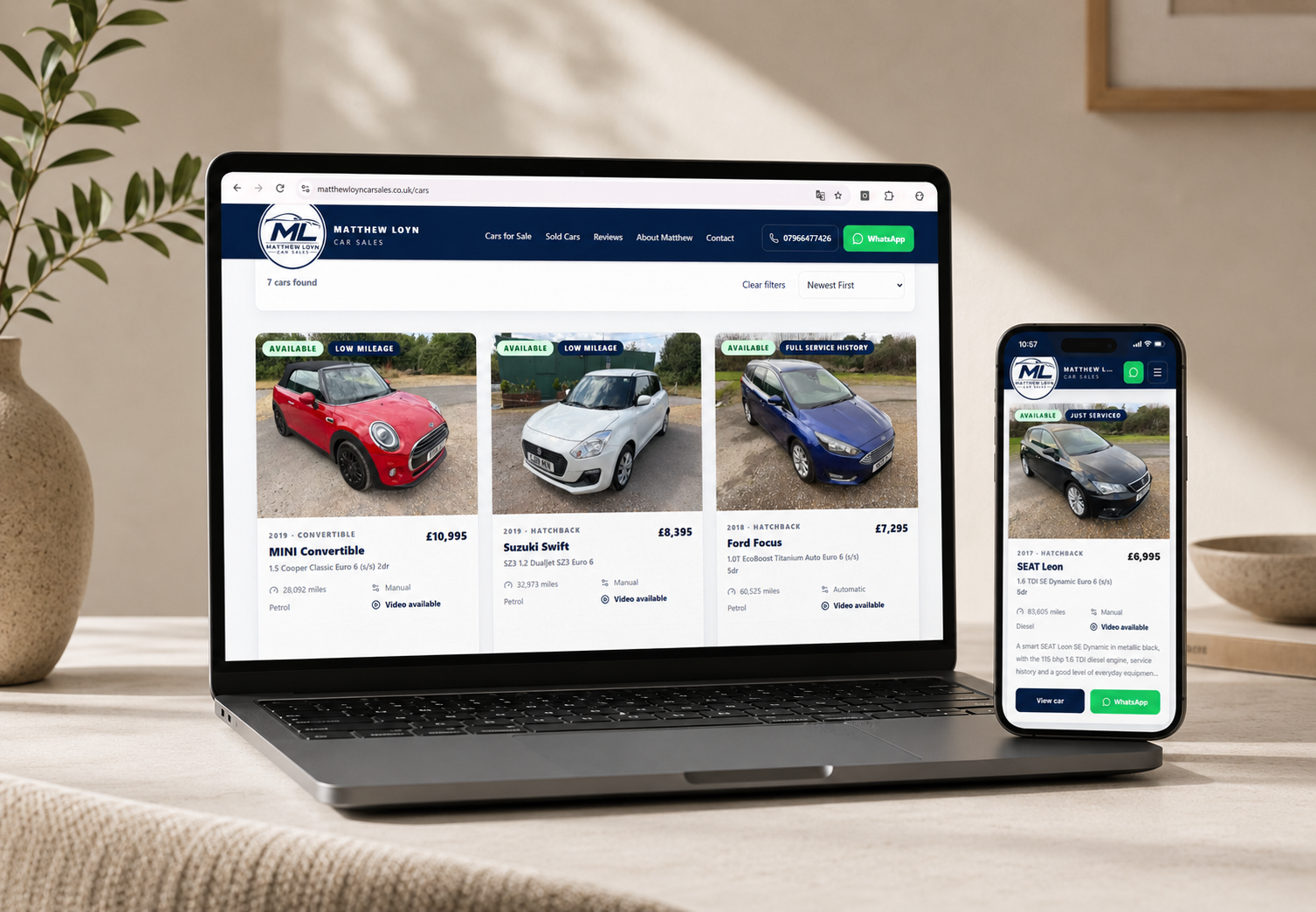
Responsive website for Matthew Loyn Car Sales, an independent used car dealer in Cardiff.

The situation

Matthew had already found a way of selling cars that suited him.

After more than 25 years in the motor trade, he didn’t want to run a large forecourt with dozens of cars and a sales process built around volume. He preferred keeping a smaller stock, choosing cars carefully and seeing customers by appointment.

That personal side matters.

Matthew knows what he has bought, can explain why he bought it, and can talk to a customer properly about whether a particular car might suit them. Many customers come back when it is time to change their car, and friends and family often find their way to him too.

So there was nothing here that needed “digitally transforming” for the sake of it.

What was missing was the digital side around that way of working.

People might first discover a car on Facebook, Instagram, Google or another advertising platform. They needed somewhere useful to go next — ideally straight to the car they had just seen — where they could look through the photos, watch a video, read the details and get a feel for who they would actually be buying from.

Matthew also needed a practical way to keep the website up to date himself.

Cars come in, photographs change, prices change, vehicles are reserved and then sold. Having to call a developer every time something changed would have made the website another job to manage rather than something that helped.

So the question wasn’t really, “Does Matthew need a website?”

It was:

What does a website need to do to be genuinely useful to this particular business?

What we did

  • We started with the way a customer already discovers and buys a car from Matthew, rather than with a standard checklist of dealership website features.
  • Someone can now see a car in an advert and go directly to that vehicle on the website instead of landing on a generic homepage and having to find it again.
  • The individual car pages were built around the things a real buyer is likely to want to know: photographs, video, mileage, specification, service history, price and a straightforward description — including Matthew’s own view of the car.
  • Contact stayed deliberately simple. A customer can call, use WhatsApp or request a viewing. We didn’t put an account, login or automated sales funnel between Matthew and somebody who simply wants to ask about a car.
  • The site was also designed mobile-first, because a large proportion of those visits start on a phone after somebody has seen a car on social media or followed a shared link.
  • Behind the public website, we built a simple admin area around the jobs Matthew actually needs to do. He can add a car, edit its details, upload and reorder photographs, change its status and move it naturally from available to reserved or sold.
  • Sold cars stay on the website in their own area rather than disappearing. They show the kind of stock Matthew has sold before, preserve old links and add some history and reassurance without getting in the way of cars that are currently available.
  • Enquiries are saved rather than existing only as an email notification. Reviews can be checked before publication. Vehicle information can feed into invoices, and a QR code on the invoice can take a customer back to leave a review after the sale.
  • We also added straightforward source tracking. Matthew can see whether somebody arrived from Facebook, Instagram, Google or another source and whether they viewed a car, clicked WhatsApp, called or requested a viewing. That gives him useful information about which advertising is actually doing something — without turning the site into a heavy tracking system.
  • And just as importantly, we left quite a lot out.

No customer accounts.

No online payments.

No finance calculator.

No oversized CRM.

No complicated user roles.

No features added simply because another dealer website happened to have them.

  • There is room to add more later if the business genuinely needs it. It just doesn’t have to carry that complexity now.

Results

The website now feels like part of Matthew’s business rather than a separate technology project sitting beside it.

A customer can go from seeing a particular car in an advert to looking at that same car in detail, understanding a little more about the person selling it and contacting Matthew directly.

Matthew can keep the stock up to date himself without touching the code or asking somebody else to make every routine change.

Cars, photographs, enquiries, reviews, invoices and basic advertising-source information are connected in one place instead of being a collection of separate little jobs.

And the personal part of the business is still personal.

The website handles the information around the sale.

Matthew still handles the customer.

What we learned

It would have been very easy to start this project with a list of things a “modern car dealer website” is supposed to have.

That would probably have produced a bigger website.

It wouldn’t necessarily have produced a better one.

The useful starting point was understanding what Matthew already did well and making sure technology didn’t get in the way of it.

His judgement about the cars is valuable. His relationship with customers is valuable. The fact that people deal with him directly is valuable.

Those weren’t problems to automate away.

Technology made much more sense around the edges — keeping stock organised, giving each car a proper place online, connecting advertising with the right vehicle, retaining enquiries, helping with invoices and showing which channels are bringing people in.

Sometimes a good digital project is as much about what you decide not to build as what you do.

A useful system shouldn’t make a small business start behaving like the software.

The software should learn how to fit the business.