How I work

A clear way from “something isn’t working” to knowing what to do next.

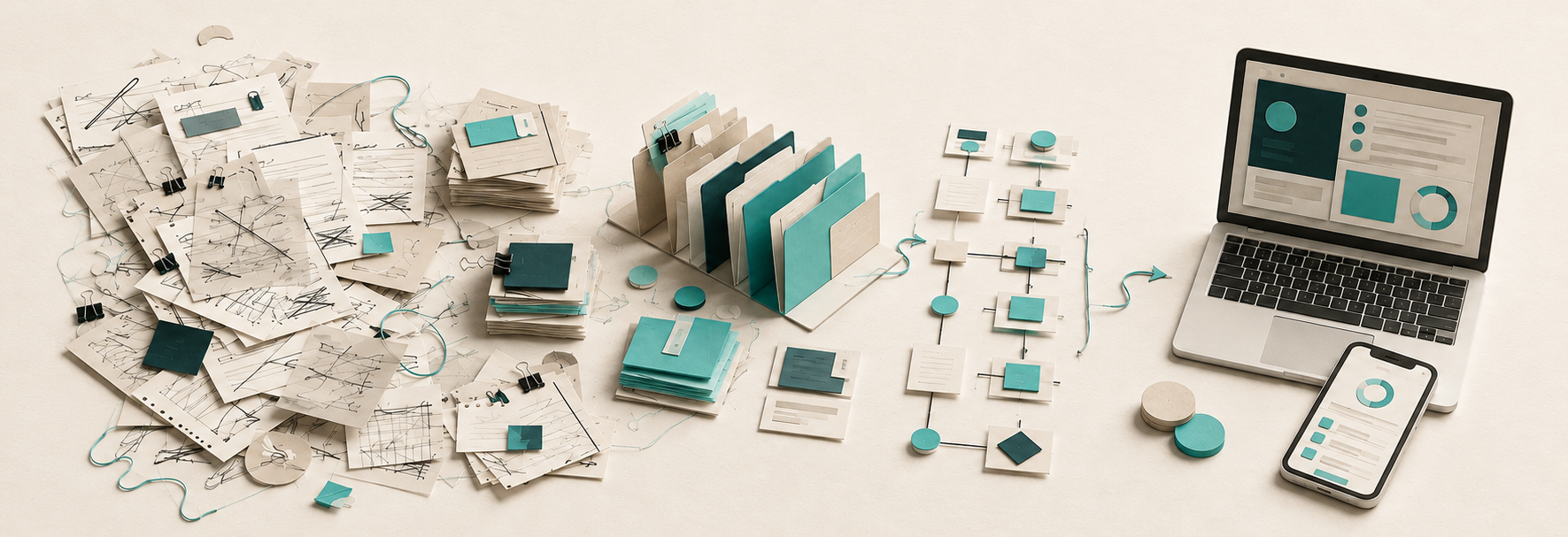
Every project is different, but the basic approach is the same: understand what’s happening, work out what needs to change, put that change into practice, and see what changed as a result.

  1. CLARIFY
  2. IMPROVE
  3. ACT
  4. MEASURE

CLARIFY

See what actually happens, not what the process says should happen.

I start by looking at what happens now — talking to the people involved, following the work from beginning to end, and seeing how information, decisions and systems fit together.

This gives us a clear picture of how things really work day to day, where they start to become difficult, and what may be causing it.

IMPROVE

Change what needs changing. Leave what works alone.

With the problem understood, the next step is to decide what is worth changing and how far that change should go. Sometimes a small adjustment is enough; sometimes the process needs a more fundamental rethink.

The goal is to make the work simpler and easier to sustain without creating new problems somewhere else.

Improvement doesn’t mean redesigning everything. It means making the changes the business actually needs — and no more than that.

ACT

Make the change real.

Once we know what the better way should look like, the next step is to make it happen. That may mean changing the way a process runs, automating part of the work, connecting existing systems, or building something new.

But a change only works if the people doing the job can actually use it. It needs to make sense in their day-to-day work, not just look good in a plan or satisfy a management requirement.

If people are expected to use a new process or system but still keep the old spreadsheet open on the side, reach for a calculator, or quietly carry on doing things the old way because it feels easier, then the change hasn’t really happened.

What matters is putting something in place that people can work with comfortably — and that genuinely makes the job easier, clearer or more effective.
MEASURE

Know what changed — not just how it feels.

A change should leave us with something we can compare. So we establish a starting point and, once the new way of working has had time to settle, look at the same things again.

That could be time spent on a task, the number of manual steps, errors, repeat work, response times, conversion, cost — whatever matters most in that part of the business.

The result should be something we can point to: this used to take 40 minutes and now takes 15; this happened 20 times a week and now happens 5; this improved by 30%.

Not every benefit fits neatly into a number. But wherever it can be measured, it should be. “It feels better” is useful to hear. Knowing what became better — and by how much — tells us what the change actually achieved.