Most retailers spend their lives trying to keep their doors open. Spirit Halloween built an empire by closing them.
Imagine opening a shop, spending weeks getting it ready, hiring staff, filling the shelves, attracting customers — and then deliberately shutting the whole thing down just as everyone starts recognising your name.
Your accountant might have questions.
Yet every autumn, more than 1,500 shops across North America do something remarkably similar.
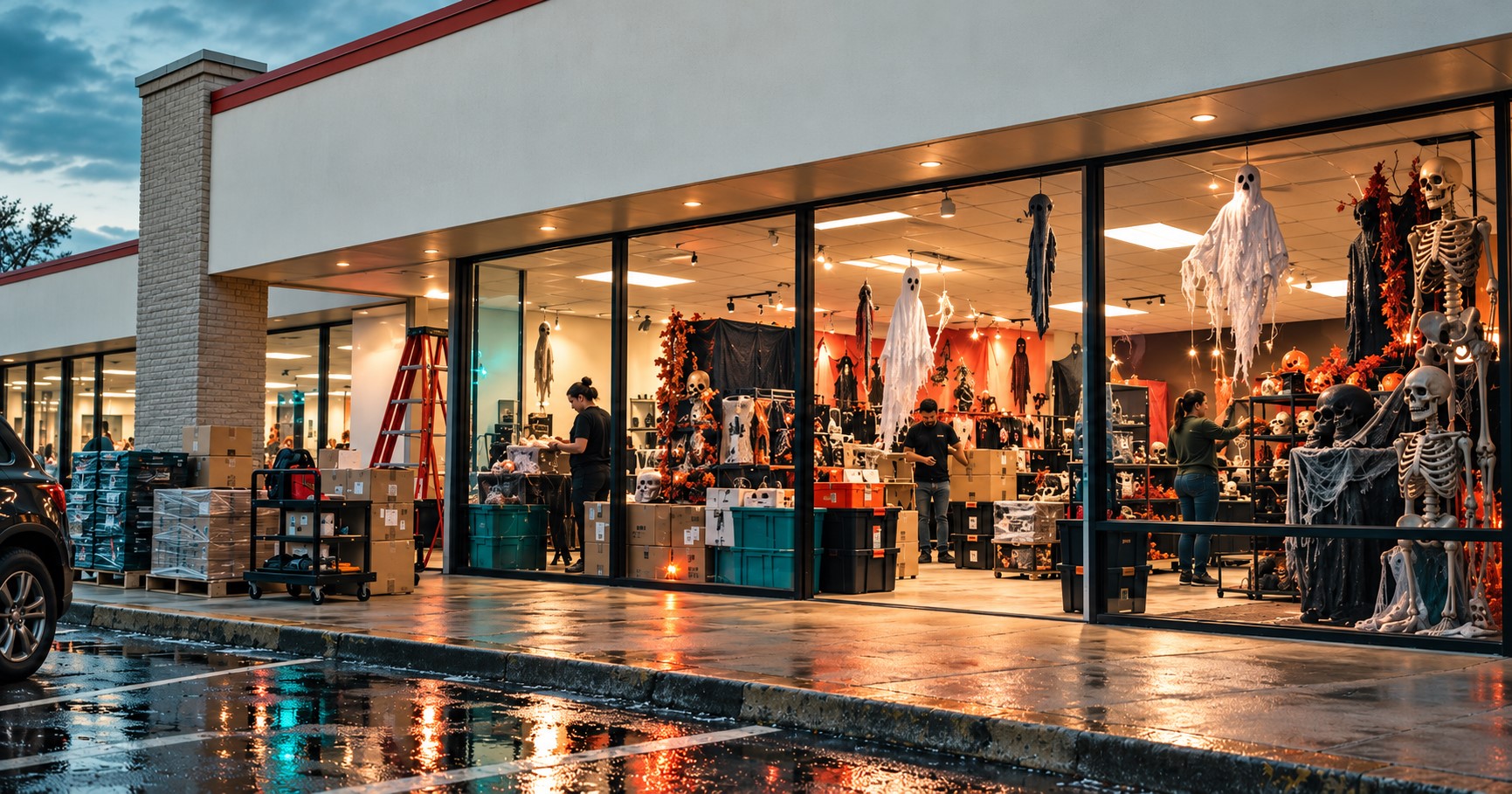
One week, there's an empty unit where a furniture shop or supermarket used to be. Then an enormous orange sign appears. Suddenly the place is full of skeletons, witches, costumes, fog machines and things that jump out at you when you're least expecting it.
By November, it's over.
The decorations come down. The staff leave. The shop disappears.
And next year, the whole extraordinary operation happens again.
Welcome to Spirit Halloween — a business that has made temporary retail into something rather permanent.
It started with a rather inconvenient discovery
In 1983, Joe Marver was running a women's clothing business in California.
He wasn't looking to reinvent retail. He was selling clothes.
But there was a small problem with his perfectly sensible business model: a little section devoted to Halloween was doing astonishingly well.
Costumes. Decorations. Seasonal nonsense.
The sort of merchandise a serious clothing retailer might consider a useful extra, not the main event.
Except customers appeared to disagree.
Marver noticed that Halloween products could outperform the clothing he was supposed to be selling.
Now, there are several ways to respond when a small, supposedly unimportant part of your business starts outperforming everything else.
You could expand the clothing range. Launch a loyalty scheme. Redesign the shop. Hire a consultant to produce a presentation explaining why customers really ought to buy more dresses.
Or you could pay attention.
Marver chose the last option.
He opened the first Spirit Halloween store in 1983.
It was a beautifully simple idea: instead of treating Halloween as a small seasonal department inside an ordinary shop, why not build the entire shop around Halloween?
There was just one obvious difficulty.
What happens to a Halloween shop in February?
The empty shops were the opportunity
For a conventional retailer, an empty shop is usually bad news.
For a landlord, it's lost rent.
For the surrounding shopping centre, it's another dark window reminding everyone that the high street isn't having its finest decade.
Spirit Halloween looked at those same empty units and saw something else.
Ready-made retail space.
No need to build a permanent shop. No need to commit to a lengthy lease if a short-term arrangement could be negotiated. No need to keep the lights on in March when hardly anyone is urgently shopping for a vampire cape.
The company could move into vacant premises for the Halloween season, sell what people wanted, then leave.
The landlord earned something from an otherwise empty property.
Spirit got access to established retail locations without having to operate them throughout the year.
Two problems, one arrangement.
And rather more skeletons than the average commercial property transaction.
The really clever bit isn't the costumes
It's tempting to look at Spirit Halloween and conclude that somebody discovered Americans really love dressing up as monsters.
True enough.
But that doesn't explain how a seasonal shop became a continent-wide operation.
The interesting part is what happens behind the orange signs.
Each year, the business needs to identify suitable premises, negotiate access, organise deliveries, prepare stores, recruit seasonal teams, manage stock and open hundreds upon hundreds of locations within a narrow window.
Then it needs to reverse much of that operation.
Imagine having to launch a shop in your town.
Now imagine launching more than 1,500 of them across North America, with Halloween approaching whether you're ready or not.
You can't spend six months arguing about the best position for the till.
You can't redesign every shop from scratch.
You certainly can't afford a different operational masterpiece in every location.
What makes the model possible is repeatability: established store formats, seasonal planning, coordinated logistics and teams who know what needs to happen.
The customer sees a haunted house.
Behind it is a rather disciplined operation.
And that contrast is what makes the story so interesting.
A business selling chaos, powered by organisation.
Then somebody decided to make it much bigger
In 1999, Spencer's acquired Spirit Halloween, which had 63 stores at the time.
This could have been the moment when the original idea disappeared into a larger retail organisation.
You know how these things sometimes go.
New management arrives. Someone announces a strategic review. The distinctive little business acquires twelve reporting dashboards and an ambitious plan to become a comprehensive lifestyle destination.
Fortunately, Spirit's seasonal model survived.
And grew.
By 2013, the chain had passed 1,000 locations.
For the 2026 Halloween season, Spirit announced more than 1,550 stores across North America.
A business that began with one shop had become an enormous annual retail operation.
And it still doesn't need most of those physical shops in February.
There is an important distinction here: Spirit itself doesn't disappear. Its website operates year-round, and a substantial amount of planning takes place between seasons.
It's the physical shops that come and go.
Which makes the model more impressive, not less.
Behind the temporary storefronts sits a permanent organisation built to make temporary retail work.
But surely closing for most of the year is a disadvantage?
Well, yes.
And no.
Spirit has a limited selling window. Halloween doesn't politely move to December because a delivery was delayed. Unsold seasonal stock isn't necessarily easy to shift in January.
A short trading season creates very real pressure.
But it also removes an enormous temptation: trying to sell something to everyone, every day, all year.
Spirit doesn't need to convince people to celebrate Halloween in April.
It doesn't need to fill quiet months with unrelated products simply to justify keeping every physical location open.
Instead, the company concentrates its physical retail presence around a period when customers are already looking for exactly what it sells.
That is a very different problem from operating a general shop and desperately trying to manufacture demand every Tuesday afternoon.
And it raises an interesting question.
How many businesses are spending money trying to maintain activity when their customers don't particularly need them?
The part worth stealing
No, I'm not suggesting you close your business for ten months and reopen dressed as a witch.
Although depending on your industry, it might improve the Monday meetings.
The useful idea is something else.
Spirit Halloween didn't simply find a popular product. It found a way of organising the business around the actual pattern of demand.
And it recognised that something another business considered a problem — empty retail space — could become an advantage.
That's a combination worth thinking about.
Consider a small service business that gets most of its enquiries during a particular season, yet maintains the same staffing, marketing and administrative routines throughout the year.
Or a company paying for permanent capacity that customers only need occasionally.
Or a business offering fifteen different services because, over the years, nobody quite got around to asking whether all fifteen still make sense.
The answer won't necessarily be to do less.
It might be to change when you do things, how you organise them, or what you're paying to keep available.
Sometimes automation is exactly the right answer.
Sometimes the cleverest improvement is a new process.
And sometimes it's realising that the process you're about to automate shouldn't exist in its current form at all.
One final thought
There's something wonderfully absurd about Spirit Halloween.
A retailer that turns the failure of other shops into its own opportunity. A business that spends months preparing to trade for a relatively short season. A company whose customers happily queue up to buy things designed to frighten them.
Yet underneath all the fake cobwebs is a very sensible business decision.
Spirit didn't try to make Halloween last all year.
It built an organisation around the fact that it doesn't.
And perhaps that's the most interesting question to take away from this story:
What if the thing you're treating as a limitation is actually telling you how your business should work
Sometimes the best business improvement isn't adding something.
It's finally noticing what you never needed in the first place.