The Customers Weren't Lazy. The Business Was Making Them Work.
One company tried to make shopping better by giving people more choice. Customers responded by leaving. The solution was almost embarrassingly simple.
A box of wonky vegetables and a very expensive misunderstanding
Imagine you've decided to do something good.
You want to eat better, waste less food and save a bit of money. Perhaps you'd even like to feel mildly superior to the perfectly symmetrical carrots in your local supermarket.
Then you discover a company delivering perfectly edible, slightly odd-looking fruit and vegetables that would otherwise struggle to find a buyer.
Brilliant.
You visit the website.
And now there's a job to do.
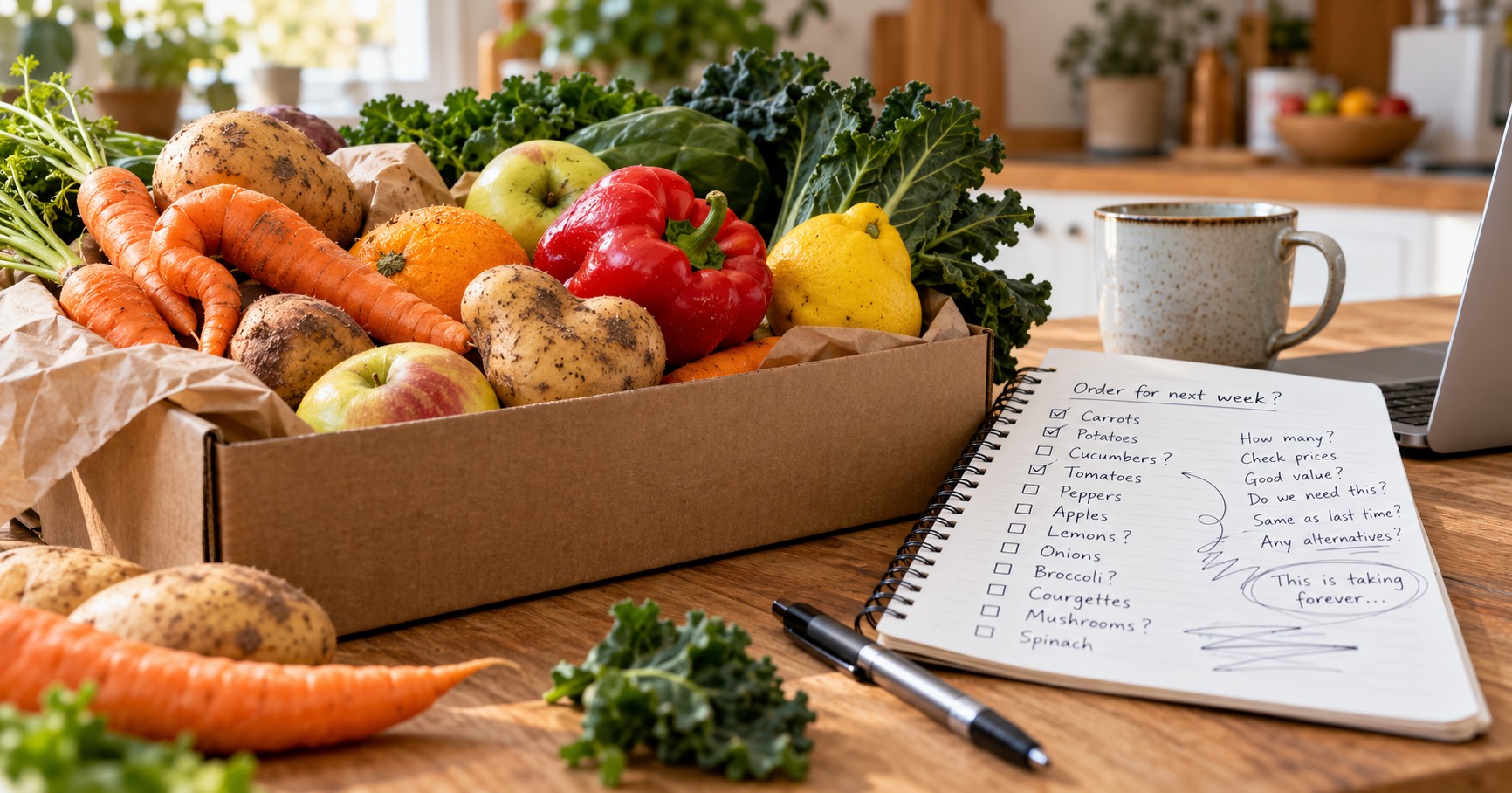
Choose your vegetables. Check the individual prices. Decide how much of everything you need. Work out whether it's good value. Repeat next week.
Suddenly, rescuing vegetables feels suspiciously like organising a small procurement department.
You only wanted some carrots.
This is more or less the problem Canadian produce delivery company Odd Bunch ran into.
And it's a rather good illustration of something businesses get wrong all the time.
They confuse giving customers more control with giving customers a better experience.
Those are not always the same thing.
The brilliant idea nobody particularly wanted
Odd Bunch was built around an appealing proposition: take fresh, perfectly good produce that doesn't meet conventional retail standards and deliver it to households at a discount.
An ugly potato is still a potato.
A crooked cucumber doesn't suddenly forget how to be a cucumber.
And if there's an opportunity to reduce food waste while saving customers money, everybody ought to be happy.
Except the business had a problem.
Founder Dijay Ojha explained on the Shopify Masters podcast that customers were becoming increasingly dissatisfied. Subscribers were leaving, engagement was falling, and the feedback wasn't encouraging.
The surprising part?
One of the things customers disliked was a feature Ojha had thought would make the service better.
Individual pricing and the ability to choose exactly what went into an order.
From the company's perspective, this made perfect sense.
Customers could select what they wanted. They could see the price of each item. They had flexibility.
What could possibly be wrong with that?
Quite a lot, apparently.
Because while the business saw flexibility, customers were experiencing effort.
And effort is a cost, even when nobody puts it on the invoice.
The customer was buying convenience. The business was selling homework.
Think about what customers actually wanted from Odd Bunch.
Affordable fresh produce.
Less waste.
Something useful arriving at their door without much fuss.
They probably weren't waking up on Wednesday mornings excited about another opportunity to compare the prices of individual courgettes.
Yet the business had designed its service around precisely that activity.
Every order involved decisions.
Not particularly dramatic decisions, admittedly. Nobody was negotiating an international peace treaty.
But decisions nonetheless.
What should I buy? How much? What's the total? Do I need to change anything this week?
One small question rarely feels like much.
Ten small questions, repeated every week, begin to feel like a chore.
And customers have plenty of chores already.
The remarkable thing about customer friction is that it rarely announces itself as a serious business problem.
It doesn't arrive wearing a badge saying Revenue Leakage.
It looks like a form people can't be bothered to finish.
A phone call they never quite get around to making.
A quote that requires three follow-up emails.
Or a customer who simply stops ordering.
The business sees a lost sale.
The customer sees one less thing to deal with.
So Odd Bunch took something away
The company changed its approach.
Instead of asking people to construct their own orders item by item, Odd Bunch moved towards a much simpler proposition.
A box of fruit and vegetables.
Delivered regularly.
For a fixed, predictable price.
That's it.
No weekly exercise in vegetable accountancy.
No need to rebuild the same shopping basket over and over again.
The business took on more of the work of deciding what belonged in the box.
And the customer got closer to what they'd wanted in the first place.
Fresh produce, delivered conveniently.
Odd Bunch subsequently grew from serving 87 households to more than 100,000, according to the account published by Shopify.
Of course, a growing company doesn't reach that scale because of one website change alone. Many factors influence growth, and the available account doesn't isolate the effect of the new ordering model.
But the change itself is revealing.
The company had tried to create value by offering more options. It discovered that customers valued having fewer decisions to make.
It's a subtle distinction.
And an expensive one to miss.
The problem with asking customers to do your job
Once you start looking for this pattern, it appears everywhere.
Consider a perfectly ordinary business selling a service.
A potential customer visits its website.
They're interested. The service sounds useful. The price seems reasonable.
So far, so good.
Then comes the enquiry form.
Name. Email. Telephone number. Company name. Company size. Industry. Annual turnover. Project budget. Preferred contact method. How did you hear about us?
And, naturally, a little box inviting them to explain their requirements in detail.
All this before anyone has even said hello.
Somewhere in the office, someone is probably very pleased with this form.
It captures valuable information.
It helps qualify enquiries.
It integrates beautifully with the CRM.
It produces lovely, tidy records.
There is just one tiny issue.
The person filling it in isn't being paid to maintain your CRM.
They're trying to find out whether you can help them.
The business has shifted part of its internal administrative work onto the customer, then called it an efficient process.
Perhaps it is efficient.
For the business.
That's not necessarily the same thing.
And the customer is perfectly entitled to decide that life is too short.
Not every obstacle looks like an obstacle from the inside
This is where customer friction becomes especially interesting.
The people who design a process usually know far too much about it.
They understand why certain information is required.
They know what happens after the form is submitted.
They know which department deals with which question.
They know why customers must create an account, confirm their email address and wait for an approval before doing the thing they came to do.
To them, the process is logical.
Every step has a reason.
And that's precisely the problem.
A process can make complete sense internally while making almost no sense to the person using it.
Take a business that requires customers to phone for a price.
Perhaps its pricing really is complicated.
Perhaps there are good reasons for discussing individual requirements.
But perhaps the business simply hasn't worked out a clear way to present its pricing.
Instead of solving that problem, it asks every prospective customer to make a phone call.
Or take an online retailer that reveals delivery charges only at the final checkout stage.
From an operational perspective, there might be a perfectly understandable explanation.
From the customer's perspective, the price has just changed.
Explanations don't automatically make the experience better.
Sometimes they simply explain why it's annoying.
The dangerous phrase: "But we've always done it this way"
There's another reason these problems survive.
Businesses get used to them.
If a process has existed for years, the effort it requires gradually becomes invisible to the people running it.
Nobody notices that customers must provide the same information twice.
Or that a simple appointment requires four messages.
Or that someone must download a document, sign it, scan it and email it back.
Or that the promised quick registration takes longer than choosing a mortgage.
Well, perhaps not quite.
But you get the idea.
And when customers complain, the instinctive response is often to explain the process.
Why that form is necessary.
Why the information can't be shared earlier.
Why they need to speak to three different people.
Why the system works the way it does.
The explanation might be entirely accurate.
It also might be completely irrelevant.
Because the question isn't whether the process can be justified.
The question is whether the customer should have to go through it at all.
Before you automate it, ask why it exists
This is where the story becomes particularly relevant to business improvement.
Imagine the original Odd Bunch ordering process.
A business analyst could have made it faster.
A developer could have redesigned the product selection interface.
An automation specialist could have introduced saved shopping baskets, clever recommendations and personalised reminders.
An AI assistant could have helped customers decide which vegetables to buy.
All perfectly reasonable possibilities.
But notice what those solutions have in common.
They assume customers should continue doing the selecting.
They improve the activity without questioning why customers are being asked to perform it.
Odd Bunch did something more fundamental.
It reconsidered the activity itself.
And that distinction matters far beyond online shopping.
If customers are struggling to complete a complicated process, the answer isn't always a better interface.
Sometimes it's fewer steps.
Sometimes it's clearer information.
Sometimes it's a different way of delivering the service.
And sometimes it's removing the process entirely.
Technology is wonderful at making things happen faster.
Unfortunately, it can also help us do unnecessary things at extraordinary speed.
A beautifully automated inconvenience is still an inconvenience.
The little experiment most businesses could try tomorrow
Here's a useful exercise.
Pretend you know absolutely nothing about your own business.
You don't understand its internal departments.
You don't know why certain forms exist.
You have never seen its procedures.
You are simply a person who wants to buy something, book something, ask a question or get a problem solved.
Now try doing that.
Not as the owner.
Not as the manager.
As an ordinary customer.
How many decisions must you make?
How often are you asked for information the business could reasonably obtain itself?
Where do you have to wait?
What happens if you don't understand something?
And perhaps most importantly:
At what point does the business stop helping you achieve your goal and start asking you to help it run its own operation?
You might discover that the problem isn't your marketing.
Or your pricing.
Or the quality of your product.
It's the amount of effort required to get to the good bit.
That won't be true of every business, and not all friction is unnecessary. Sometimes a little extra effort provides reassurance, improves security or helps people make better decisions.
The aim isn't to eliminate every question or turn every purchase into a one-click transaction.
It's to understand which steps genuinely help the customer — and which ones exist mainly because they're convenient for the organisation.
That's where the interesting improvements begin.
Sometimes better means less
Odd Bunch didn't need to persuade customers that imperfect vegetables were worth buying.
They already liked the idea.
The company needed to stop making the buying process harder than the benefit justified.
And that's what makes this story worth remembering.
Businesses are extraordinarily good at adding things.
More features.
More options.
More questions.
More ways to personalise the experience.
More technology to manage everything we've added.
Much less often do we ask whether customers wanted any of it in the first place.
Sometimes the smartest business decision isn't to create another feature.
It's to remove one.
And sometimes the best customer experience is the one where the customer barely notices a process exists.
Because they're too busy enjoying what they actually came for.
Your customers didn't come to work for your business.
They came because they hoped your business would do something for them.