The Most Expensive Word in Business Is Probably 'More'
Why do we keep adding people, processes and technology to solve problems — even when the smartest solution might be to take something away?
When people were asked to improve something, their first instinct was usually to add something.
A new feature. Another component. One more step.
Almost anything, it seemed, except taking something away.
In 2021, researchers at the University of Virginia and their collaborators published a rather uncomfortable discovery about the way we solve problems.
They found that people systematically overlook opportunities to make things better by removing something.
Not because removing things is necessarily difficult.
Not because the alternatives are always better.
But because the possibility of subtraction often doesn't occur to us in the first place.
And once you start looking for this habit, you see it everywhere.
Overloaded employees? Hire someone.
Too many mistakes? Introduce another approval.
Customers waiting too long? Buy a new system.
Meetings unproductive? Schedule a meeting to discuss the meetings.
We call it improvement.
Sometimes it is.
And sometimes we're simply building a more expensive version of the problem we already had.
The researchers decided to investigate this peculiar instinct. And one of their experiments involved a little plastic man, a precarious Lego structure and a surprisingly good test of human intelligence.
The results were not entirely flattering.
One Lego man. One unstable roof. Most people missed the obvious.
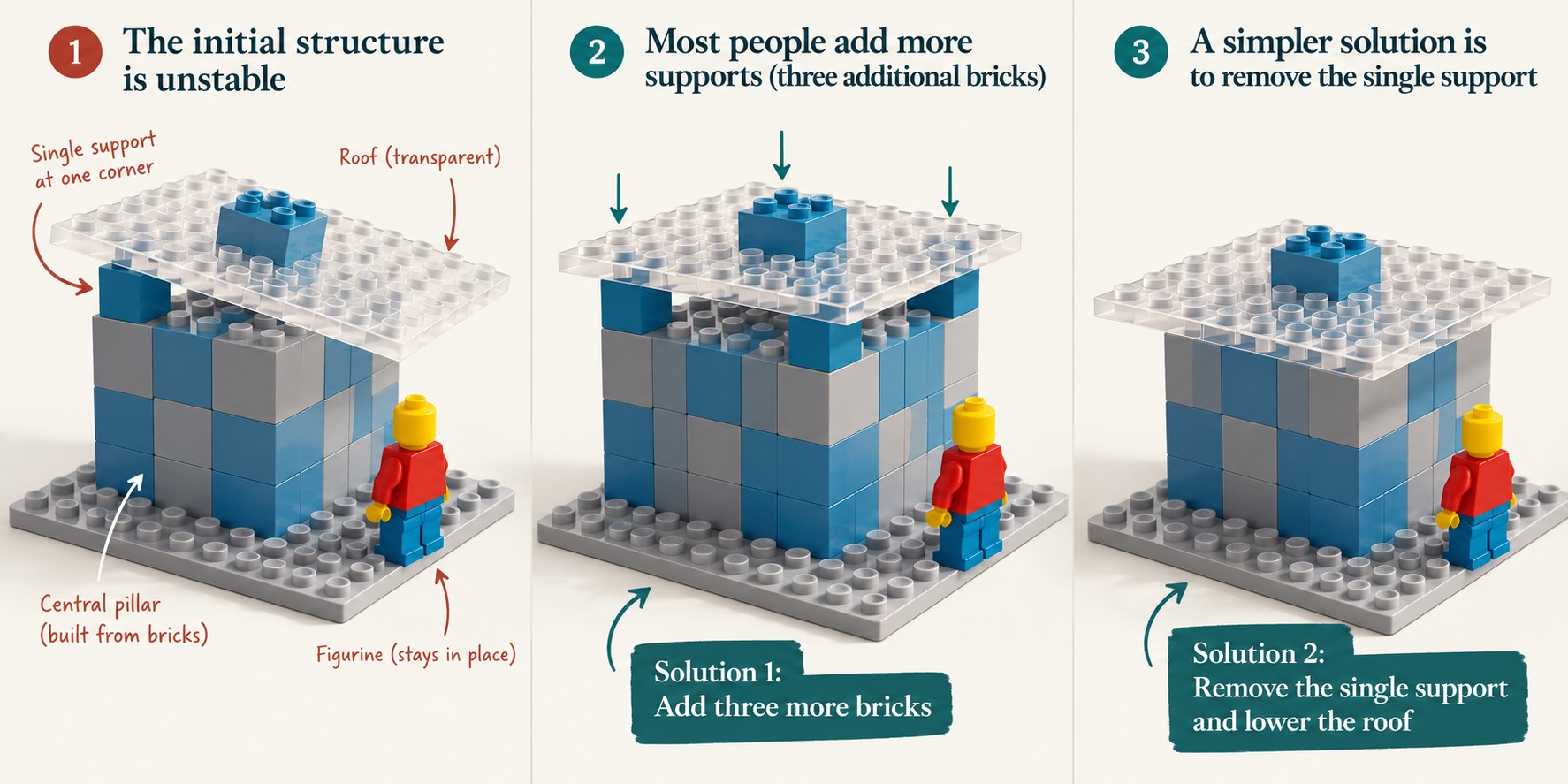
Imagine a small Lego structure.
There's a little plastic figure standing underneath a flat roof. The roof is raised above him by a single Lego block supporting one corner. The rest of the roof is unsupported, although there's another layer of Lego immediately beneath it.
The roof is unsteady.
Now imagine placing a heavy building brick on top.
Without some modification, the roof will tip and collapse.
The researchers offered participants a challenge: make the structure stable enough to support the brick without crushing the little man.
There's a reward of $1 for success.
You can use additional Lego pieces, but each one costs ten cents from your reward.
So what do you do?
The obvious answer is to strengthen the roof.
Add another support.
Perhaps two.
Possibly three, one at each of the remaining corners.
Now the roof has four supporting points. The brick stays up. The little man survives.
Excellent engineering.
Except you've spent thirty cents.
And the researchers had arranged the structure so that there was a much simpler solution.
Remove the one existing support.
The roof drops down by the height of that single Lego block and rests flat on the lower layer of the structure.
It doesn't collapse onto the figure. There's still enough room beneath the lowered roof for him to stand safely.
And because the roof now rests on a stable layer rather than balancing on one corner, it can support the weight.
The little man survives.
Nothing has been added.
You keep the entire dollar.
Once you understand the solution, it feels almost ridiculously obvious.
Yet many participants chose to add supports rather than remove the original one.
They looked at an unstable structure and immediately started thinking about what was missing.
More supports. More stability. More Lego.
The problem wasn't that the structure needed something added. The problem was that something already there was making it unstable.
And somehow, that possibility escaped most people.
If you've ever spent six months implementing a new business system only to discover that half the work it manages was unnecessary, this might sound painfully familiar.
An entire university was invited to make things better. Guess what happened?
The researchers examined something rather more grown-up than Lego.
An incoming university president had invited people to submit ideas for improving the institution.
A perfectly reasonable request.
Universities, after all, have plenty of things that could be improved.
Teaching, administration, student services, bureaucracy, communication, scheduling.
There's no shortage of possibilities.
The researchers analysed 651 responses that could be classified as proposing either additions or removals.
Only 70 suggested removing something.
Just 11%.
The remaining 89% proposed some form of addition.
Now, perhaps many of those suggestions were excellent.
The researchers weren't claiming that subtraction is always superior.
What makes the result fascinating is the imbalance.
Give people an open invitation to make an organisation better, and the overwhelming instinct is to introduce something new.
Very few people look at what's already there and ask whether any of it could disappear.
Which is especially interesting in a university.
An institution full of people professionally employed to question assumptions.
Apparently, we're all rather good at questioning other people's assumptions.
Our own administrative procedures are another matter.
Why does doing more look so much like doing better?
There's something reassuring about an additive solution.
You can see it.
A new employee arrives.
A new system goes live.
A new policy is published.
A new department appears on the organisational chart.
Something has happened.
Management has taken action.
Progress is being made.
Now imagine a different scenario.
Two managers are competing for approval of their improvement proposals.
The first wants to introduce a new reporting platform.
It will consolidate information from several departments, automate weekly reporting and produce detailed performance dashboards.
The project will take four months.
It needs a budget, a project manager, training sessions and a formal launch.
The second manager has a slightly less glamorous proposal.
Stop producing a report nobody reads.
That's it.
No software.
No implementation.
No launch party.
Just stop.
Which manager looks more ambitious?
Which proposal feels more substantial?
And which one is more likely to be described in the annual report as a major business improvement initiative?
Yet suppose that forgotten report takes three employees two hours each week to prepare, review and distribute.
That's six hours every week.
More than 300 working hours a year.
Spent producing something that nobody uses.
Removing it costs nothing.
No procurement process.
No implementation partner.
No training.
And nobody has to remember another password.
It's a hypothetical example, but it illustrates a very real problem.
Businesses have a strange tendency to reward visible activity more readily than the absence of unnecessary activity.
Adding something demonstrates effort.
Removing something can look suspiciously like doing nothing.
And that may be one reason complexity survives long after its usefulness has expired.
How a temporary fix becomes a permanent department
Imagine a company that once sent the wrong document to an important customer.
It caused embarrassment.
The customer complained.
Management quite reasonably decided that something had to change.
So they introduced an additional checking stage before documents were sent.
Problem addressed.
Six months later, another mistake happened.
This time, a manager had to approve every document.
A sensible precaution.
Then approvals started taking too long.
So someone created a spreadsheet to track them.
Then came a weekly meeting to review delayed approvals.
Then a performance dashboard.
Then a procedure for escalating overdue approvals.
Five years later, the original incident has been forgotten.
But its descendants are thriving.
There are now three people involved in what used to be a straightforward task.
Documents move through multiple systems.
Employees complain that everything takes too long.
And customers wonder why the company can't simply send them what they asked for.
Management meets.
After reviewing the situation, someone suggests hiring an additional administrator.
Of course they do.
The extraordinary thing is that nobody involved has necessarily made a foolish decision.
Every individual addition had a plausible justification at the time.
That's how complexity accumulates.
Not through one spectacularly bad decision.
But through hundreds of reasonable little ones that nobody ever revisits.
Businesses are very good at introducing rules after something goes wrong. They're considerably less enthusiastic about retiring those rules when circumstances change.
And eventually, the business begins working for its processes rather than the other way around.
Why we keep making this mistake — especially when we're busy
The 2021 research uncovered another important detail.
People were more likely to discover subtractive solutions when they were explicitly reminded that removing something was an option.
In one set of experiments, participants were asked to suggest improvements to a miniature golf course.
When the instructions simply asked them to improve it, subtractive suggestions were relatively uncommon.
But when participants were reminded that they could add or remove elements, they became more likely to propose removing something.
The researchers also examined what happened when people were under greater cognitive load — in other words, when their minds were occupied with additional demands.
Under those conditions, useful subtractive changes were even more likely to be overlooked.
Think about that combination.
Busyness. Distraction. Pressure.
Three conditions that could almost serve as the official operating environment of modern management.
A customer is angry.
A deadline is approaching.
The team is overwhelmed.
You need an answer.
And you need it now.
So you reach for the first solution that seems sensible.
Add capacity.
Add a check.
Add a tool.
Add a person.
There may be a simpler solution, but discovering it requires something that's in painfully short supply.
Time to think.
And when you're under pressure, thinking tends to lose its place on the calendar to meetings about why nobody has time to think.
The irony would be amusing if it weren't so expensive.
Then somebody suggests automation
This is where the story gets particularly interesting.
A business eventually realises its operations have become unnecessarily complicated.
Employees are frustrated.
Information is duplicated.
Approvals take forever.
Customers wait.
Management decides it's time for digital transformation.
A new platform will automate the entire workflow.
Excellent.
Except the workflow itself remains untouched.
The new system reproduces every unnecessary step.
The same redundant approvals.
The same duplicated information.
The same reports nobody reads.
Only now, everything happens digitally.
Congratulations.
You've invested a substantial amount of money to make unnecessary work happen faster.
And this is the distinction that too often gets lost in conversations about efficiency.
Automation asks how to make a process work faster. Good business analysis first asks whether that process should work that way at all.
Those questions belong together.
But they need to be asked in the right order.
Imagine a company receiving 400 customer service requests each month.
Two coordinators spend their days collecting information, entering it into the system, checking details, assigning work and sending confirmations.
They're overwhelmed.
The business considers hiring a third coordinator.
Then someone looks closely at what the existing two actually do.
Customers are asked for information that already exists in the company's records.
The same details are entered into two separate systems.
Routine requests wait for manual approval.
Engineers receive work assignments based on who happens to answer the phone.
Customers call again because they haven't received confirmation.
None of these activities individually looks particularly dramatic.
Together, they create an extraordinary amount of avoidable work.
Now suppose the business redesigns the process.
Information is collected once.
Routine requests are routed automatically.
Customers receive confirmation without someone manually composing an email.
The coordinators spend less time moving information around and more time dealing with cases that genuinely need human attention.
Yes, some automation may be involved.
But the important improvement happened before the technology was introduced.
Someone questioned the work itself.
They asked what could disappear.
The business didn't necessarily need another coordinator.
It needed fewer reasons to keep the existing coordinators busy.
And that's a fundamentally different solution.
Of course, removing things can be a terrible idea
Before we start dismantling every process in sight, there's something worth acknowledging.
Not everything that's complicated is unnecessary.
A safety check may look like an inconvenience until it prevents a serious mistake.
A personal conversation may seem inefficient until you realise it's the reason customers trust the business.
An experienced employee may appear to spend too much time handling exceptions, when in fact they're preventing those exceptions from becoming disasters.
Simply removing steps doesn't automatically make a process better.
Sometimes it just moves the work somewhere else.
Think of a business that decides to reduce administrative work by replacing its customer service team with an automated chatbot.
Fantastic.
Fewer calls.
Lower staffing costs.
A beautifully efficient dashboard.
Meanwhile, customers are spending twenty minutes trying to persuade a chatbot to let them speak to an actual person.
The business has reduced its own workload by increasing the customer's.
That isn't necessarily improvement.
It's redistribution.
And customers aren't particularly interested in how efficient your organisation has become if dealing with it now feels like completing a government application.
The goal isn't to make the business do less. It's to stop making everyone do things that don't need doing.
That includes employees.
And customers.
Especially customers.
The question nobody really wants to ask
Imagine walking into your office tomorrow and announcing something deeply unfashionable.
"We're not introducing anything new this month."
No new software.
No additional reporting.
No extra approval procedures.
No new meetings.
Instead, every department has one assignment.
Find something we can stop doing without making the business worse.
Not something to automate.
Not something to delegate.
Not something to do faster.
Something to stop.
At first, there might be an uncomfortable silence.
Then the objections would begin.
"We've always needed that report."
"Finance requires that information."
"We can't remove that approval."
"Someone might need those figures."
Maybe they're right.
But wouldn't it be interesting to find out?
Who actually reads the report?
What decision does it support?
When was that approval last refused?
What would happen if the step disappeared?
And if nobody can explain the purpose of an activity beyond "that's how we've always done it", perhaps it deserves a closer look.
Not immediate deletion.
Just examination.
Because there's an important difference between a process that exists for a reason and one that exists because nobody remembers there was ever an alternative.
The most expensive thing might already be there
The researchers' little Lego experiment is a strangely good metaphor for modern business.
We look at something unstable and immediately search for what's missing.
Another support.
Another system.
Another person.
We see empty spaces and assume they need filling.
But sometimes the problem isn't the empty space.
It's the piece we've already put there.
The one we've become so accustomed to that we automatically treat it as essential.
Remove it, and the whole structure might become stronger.
Of course, not every business problem has a clever Lego-style solution.
Sometimes you genuinely need more staff.
Sometimes you need better technology.
Sometimes another check is precisely what prevents a costly mistake.
But there's an important difference between deciding to add something after examining the alternatives and adding it because no other possibility occurred to you.
And perhaps that's the question worth asking before your next improvement project.
Not just:
What do we need to make this work better?
But:
What have we already built that might be getting in the way?
You may discover that the most valuable thing you can introduce into your business is something you've never tried before.
A subtraction.
No project launch.
No new system.
No impressive new department.
Just a problem that no longer exists.
And people who suddenly have time to do something useful.