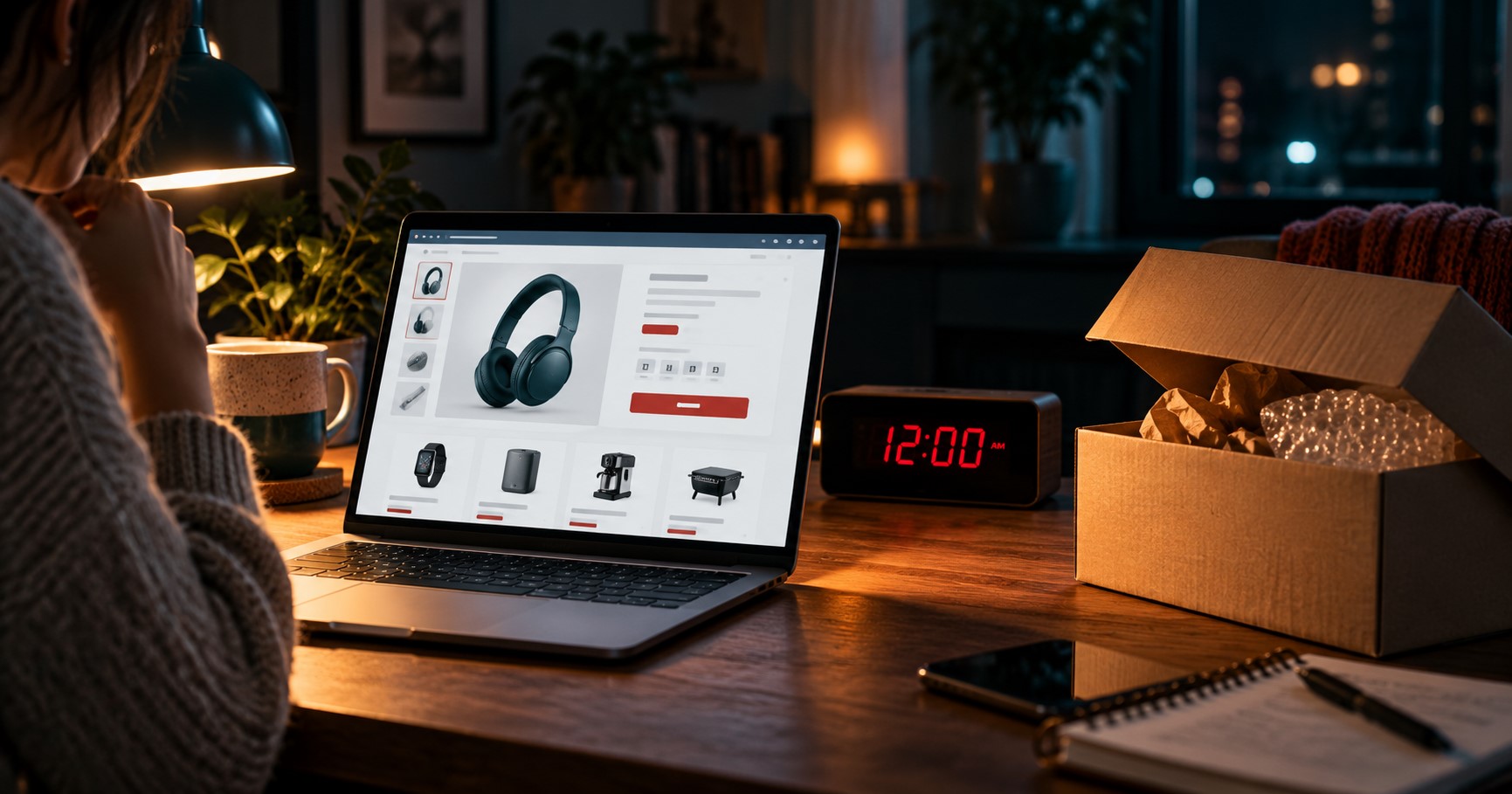
The Shop That Made People Stay Up Until Midnight
One product. One day. A new surprise at midnight. How a strange little internet shop turned discounted gadgets into something people actually looked forward to.
There's a perfectly good reason to be awake at midnight. This wasn't one of them.
Imagine it's 11:58 pm.
You've got work tomorrow. You're tired. There's absolutely nothing you need to buy.
And yet, here you are, staring at an online shop.
Not Amazon. Not eBay. Not even a particularly impressive website.
You're waiting for a shop called Woot! to tell you what it's selling tomorrow.
It might be a television.
It might be a coffee machine.
It might be something so spectacularly unnecessary that you'll spend the next five minutes convincing yourself it could change your life.
You have no idea.
And that's precisely why you're still awake.
At midnight, the page changes.
A new product appears.
You look.
You consider.
You might buy it.
You might laugh at it.
You might wonder who on earth thought anyone needed a discounted gadget designed to do something that a spoon could probably manage.
And tomorrow night?
You might be back.
Somehow, an online shop had turned the simple act of checking its prices into entertainment.
Not bad for a business selling surplus merchandise.
The internet shop that apparently hated choice
In 2004, Matt Rutledge launched Woot! in Texas with an idea that must have sounded slightly ridiculous even then.
Sell one product per day.
That's it.
At a time when online retailers were discovering the joys of enormous catalogues, limitless choice and increasingly elaborate search filters, Woot! went in the opposite direction.
One product.
One price.
Take it or leave it.
The product remained available until it sold out or was replaced at midnight, Central Time.
No scrolling through forty-seven nearly identical toasters.
No complicated comparison tables.
No urgent need to read three hundred reviews from strangers with surprisingly strong opinions about extension cables.
Just today's deal.
And a rather important catch.
If you didn't buy it, you might never see that particular offer again.
Now, scarcity isn't exactly a revolutionary commercial discovery.
Market traders have been telling people that the last one is going fast since approximately the invention of markets.
But Woot! added something rather clever.
Customers didn't know what tomorrow's deal would be.
So there were two completely different reasons to pay attention.
Today's product might disappear.
And tomorrow's might be brilliant.
Suddenly, doing nothing had consequences.
You could miss out.
Or, even worse, you could miss out on something you hadn't yet discovered you desperately wanted.
The genius was in the clock
Most online shops operate on a wonderfully straightforward principle.
You need something.
You visit.
You look for it.
You buy it.
Then, assuming the experience hasn't been disastrous, you get on with your life.
Woot! disrupted that sequence.
You didn't need anything before visiting.
You visited to find out whether there was something worth needing.
And because the offer changed at a predictable time, checking the website became a habit.
Midnight wasn't merely an operational deadline.
It was the beginning of the next episode.
Think about the difference.
A normal retailer might advertise a new offer and hope somebody notices.
Woot! could give its audience a reason to return at a particular moment, even before they knew what was being offered.
That is rather a different relationship with customers.
A supermarket doesn't normally expect you to gather at its doors at 11:59 pm to discover which brand of washing powder will be discounted tomorrow.
But Woot! made the equivalent experience feel almost reasonable.
Almost.
Then they started selling actual crap
If Woot!'s original business model was unusual, its next trick was gloriously absurd.
The company began offering something called a Bag of Crap.
The name was not an unfortunate translation.
It was a deliberate marketing decision.
Customers paid for an assortment of mystery items, without knowing exactly what they would receive.
The contents could be useful.
They could be peculiar.
They could be things that made you wonder whether the warehouse staff had been allowed to pack orders after a particularly energetic office party.
And people wanted them.
Badly.
The bags became a celebrated part of Woot!'s culture, with limited availability and enthusiastic discussions among shoppers.
Which is remarkable when you think about it.
Most businesses invest a considerable amount of effort into explaining why their products are valuable.
Woot! managed to generate excitement around a product whose defining feature was that nobody knew what was inside.
There wasn't even a reassuring promise that the contents would be especially good.
The uncertainty was part of the attraction.
People weren't simply buying objects.
They were buying the possibility of a surprise.
And, perhaps, a story worth telling afterwards.
It's difficult to imagine a traditional marketing meeting approving the presentation:
Product: unknown.
Contents: possibly rubbish.
Customer reaction: enthusiastic.
Yet somehow, that was the point.
The customers became part of the show
There was another important ingredient.
Woot! didn't behave like an ordinary retailer.
Its product descriptions were often deliberately ridiculous. Its tone was irreverent. It made jokes about its own merchandise.
And customers joined in.
They discussed offers, argued about value, shared discoveries and compared the contents of their mystery purchases.
What might otherwise have been a completely forgettable transaction acquired a social dimension.
You weren't just purchasing a discounted gadget.
You were participating in whatever strange little event Woot! had arranged that day.
A bargain might provoke excitement.
A terrible product might provoke even better jokes.
And sometimes the discussion itself was more entertaining than the thing being sold.
That's an interesting achievement.
Because products can be copied.
Prices can be beaten.
A competitor can launch a sale tomorrow.
But a community that enjoys returning to the same place, at the same time, for a shared experience?
That's rather harder to reproduce.
Woot! had discovered that people could become attached to the way a business sold things, not merely to the things it sold.
The strange little shop becomes a serious business
By 2010, Woot! was no longer merely a curious internet experiment.
It had developed a substantial following, expanded into additional product categories and attracted the attention of a rather larger online retailer.
Amazon.
In June 2010, Amazon announced it was acquiring Woot!.
The financial terms were not officially disclosed.
There is something wonderfully ironic about this.
One of the world's most famous retailers, built around offering an extraordinary range of products, bought a company that had originally made its name by offering precisely one.
Of course, Woot!'s business had already expanded beyond its original format by then.
And today's Woot! is different again, offering multiple daily deals, categories and special sales events.
But the story of its early success remains fascinating.
It proved that having more to sell isn't necessarily the same as giving people more reasons to visit.
Sometimes the second matters much more.
So should every business start a midnight sale?
Please don't.
The world has enough countdown timers.
And most people could probably do with a little more sleep.
The obvious temptation when looking at Woot!'s success is to copy the visible mechanics.
Limited stock.
A clock.
A mystery product.
Perhaps a dramatic red banner announcing that there's only one left.
But these were not magic ingredients that worked independently of everything else.
Woot! had a specific audience, particular merchandise, genuine limited availability and a personality that made the experience entertaining.
The humour mattered.
The community mattered.
The predictable timing mattered.
Even the uncertainty mattered, because customers knew when to expect it.
Remove those elements and the same mechanics can become irritating very quickly.
Think about the websites that greet you with a countdown timer every single time you visit.
The ones that announce an exclusive offer which somehow remains available for the next six months.
The ones that insist thirteen people are looking at the same product as you.
Possibly fourteen.
One may be a particularly indecisive ghost.
What Woot! built was different.
The original limitations were part of how the business actually operated.
The experience grew out of that reality.
It wasn't merely a layer of artificial excitement painted over an ordinary shop.
And customers are quite capable of recognising the difference.
The opportunity hiding inside an ordinary routine
This is where the story becomes relevant to businesses that have absolutely no intention of selling mystery boxes.
Consider a small independent retailer.
Every month, new products arrive.
The owner photographs them, uploads them to the website and posts a perfectly sensible announcement on Facebook.
New stock now available.
Nothing wrong with that.
But suppose customers began to recognise a particular day when something interesting would be revealed.
Not necessarily a discount.
Perhaps a product with an unusual story.
Perhaps something chosen by customers.
Perhaps a limited collection, a behind-the-scenes discovery or a genuinely useful demonstration.
Something people could look forward to.
The difference isn't necessarily in the merchandise.
It's in what gives people a reason to pay attention.
Or consider a service business.
Most service businesses communicate when they want something.
An enquiry.
A booking.
A renewal.
A sale.
What if there were moments when customers genuinely enjoyed hearing from them, without being asked to buy?
An amusing observation from the trade.
An unexpected discovery.
A useful answer to a question nobody thought to ask.
Something worth opening an email for.
The point isn't to create a complicated marketing campaign.
It's to understand what your customers might actually enjoy returning for.
And then find a natural way to make that part of how the business works.
The bit competitors couldn't buy off the shelf
There's a reason I find Woot! more interesting than another case study about discounting.
Discounting is easy to understand.
Lower the price. Attract attention. Hope the margin survives.
But Woot! turned its selling process into something customers anticipated.
And that is a much more unusual achievement.
Its advantage wasn't simply that people could save money.
It was that people wanted to see what happened next.
The business had effectively created a little recurring event around products that, on their own, might not have been particularly exciting.
Think about that for a moment.
A company selling discounted electronics gave customers a reason to stay awake until midnight.
Meanwhile, plenty of businesses selling genuinely excellent products struggle to persuade people to open an email at lunchtime.
Maybe the difference isn't always the product.
Maybe sometimes it's the experience surrounding it.
One last thing before midnight
Woot!'s story isn't proof that every business needs gamification.
Nor is it an invitation to manipulate customers with artificial shortages and endless urgency.
There is a real difference between creating anticipation and manufacturing anxiety.
The interesting question is what made Woot!'s customers return voluntarily.
They had fun.
They were curious.
They liked the community.
And there was always the possibility that tomorrow would bring something worth talking about.
Woot! gave people something to look forward to, even when they weren't planning to buy anything.
That's an extraordinary thing for a retailer to achieve.
And it leaves us with a question that is useful well beyond retail.
Does your business give customers a reason to come back — or does it simply hope they'll remember you the next time they need something?
Because those are two very different ways to build a relationship.
And sometimes the cleverest marketing idea isn't about finding a better way to sell.
It's about giving people a reason to show up in the first place.
Even if it's midnight.
Even if they've got work tomorrow.
And even if, when they finally open the parcel, it turns out to contain a rather questionable assortment of things they never needed.